MICCAI 2026 Strasbourg, France Sept. 27 - Oct. 1, 2026

APEX-SAM: Anatomy-Aware Prompting with Expert Retrieval for Training-Free Medical Image Segmentation

Zhihao Mao*, Bangpu Chen*, Qi Lei, Jiaqi Tan, Kun Sun
China University of Geosciences (Wuhan)
*Equal contribution Corresponding author

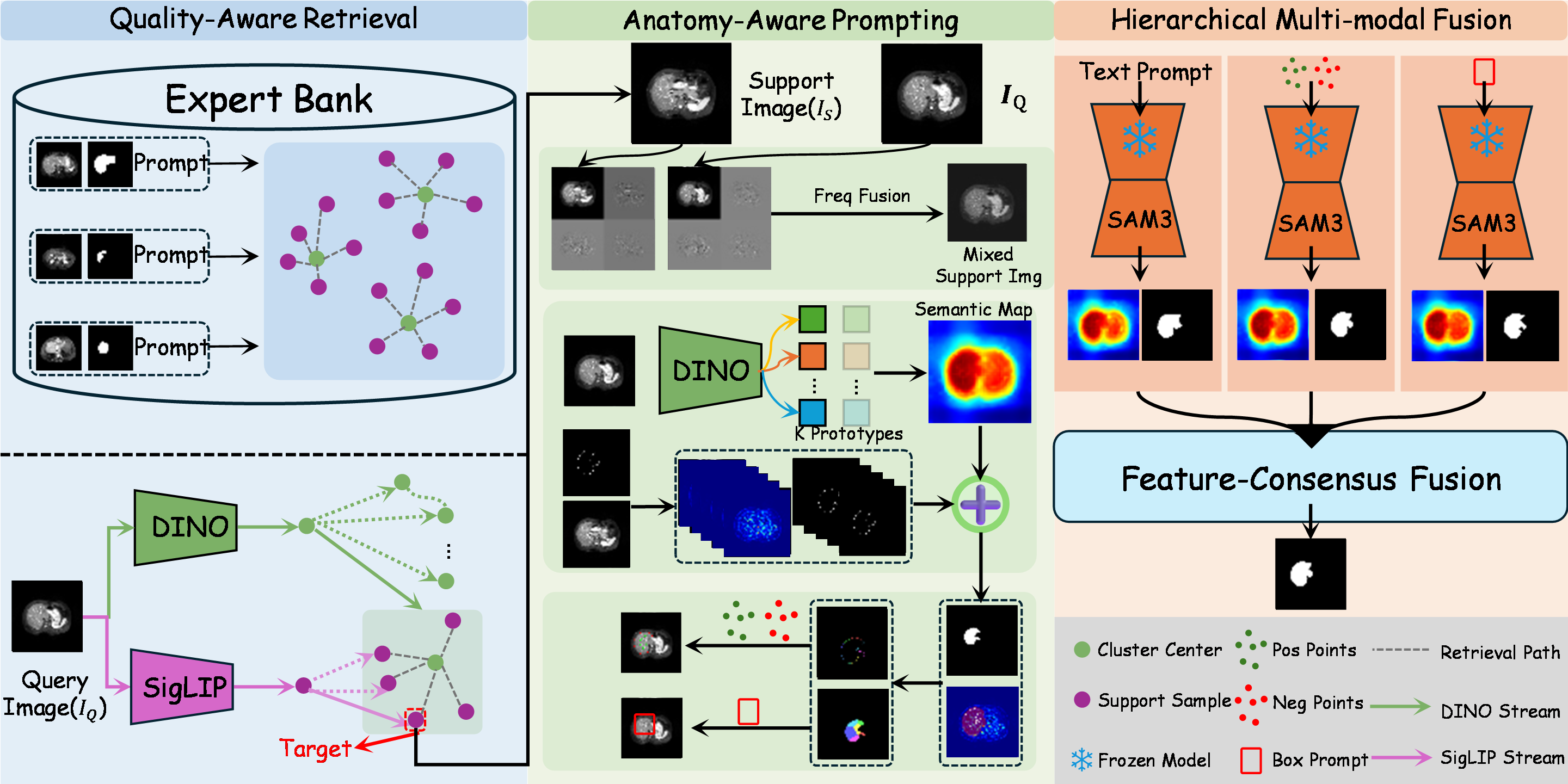
APEX-SAM is a training-free framework for cross-domain few-shot medical image segmentation. It combines quality-aware expert retrieval, anatomy-aware prompt mining, and hybrid multi-modal prompt fusion to segment unseen anatomy without parameter updates.

APEX-SAM architecture overview

Figure 1. Overview of APEX-SAM. QAR builds a hierarchical expert bank with DINO/SigLIP dual-stream indexing. APM performs style alignment, semantic gating, orientation-aware geometric alignment, and anatomy-aware point sampling. HMF fuses SAM prompt branches through training-free feature-consensus weighting.
Abstract

Training-Free Cross-Domain Segmentation

Training-free cross-domain few-shot medical image segmentation aims to segment unseen anatomies without parameter updates, addressing the high cost of dense annotation and domain-specific fine-tuning in clinical practice. Existing support-driven prompting methods face three limitations: support exemplars are randomly selected without quality assurance, geometric alignment is poorly modeled, and multi-modal prompt capabilities remain underexploited.

We present APEX-SAM, a retrieval-augmented framework with three innovations. QAR builds a dual-stream DINO/SigLIP expert bank with diversity-aware selection to ensure support-query compatibility. APM performs style-aligned geometric matching and anatomy-guided point sampling from morphological priors. HMF fuses SAM branches through training-free feature-consensus weighting. Experiments on three cross-domain benchmarks confirm strong performance among training-free methods, with ablations validating each component's contribution.
Method

Three Components, One Inference Pipeline

APEX-SAM improves support selection, prompt construction, and prompt-branch fusion while keeping the full pipeline training-free.

QAR

Quality-Aware Expert Retrieval

Builds a hierarchical expert bank using structural and semantic descriptors, then selects compatible support exemplars with quality, coverage, and diversity constraints.

APM

Anatomy-Aware Prompt Mining

Aligns support and query anatomy under cross-modality appearance shifts, then samples positive and negative prompts from morphological priors.

HMF

Hybrid Multi-Modal Fusion

Runs multiple SAM prompt branches and combines them with reliability-weighted feature consensus, avoiding learned fusion layers or fine-tuning.

Benchmarks

Cross-Domain Medical Segmentation

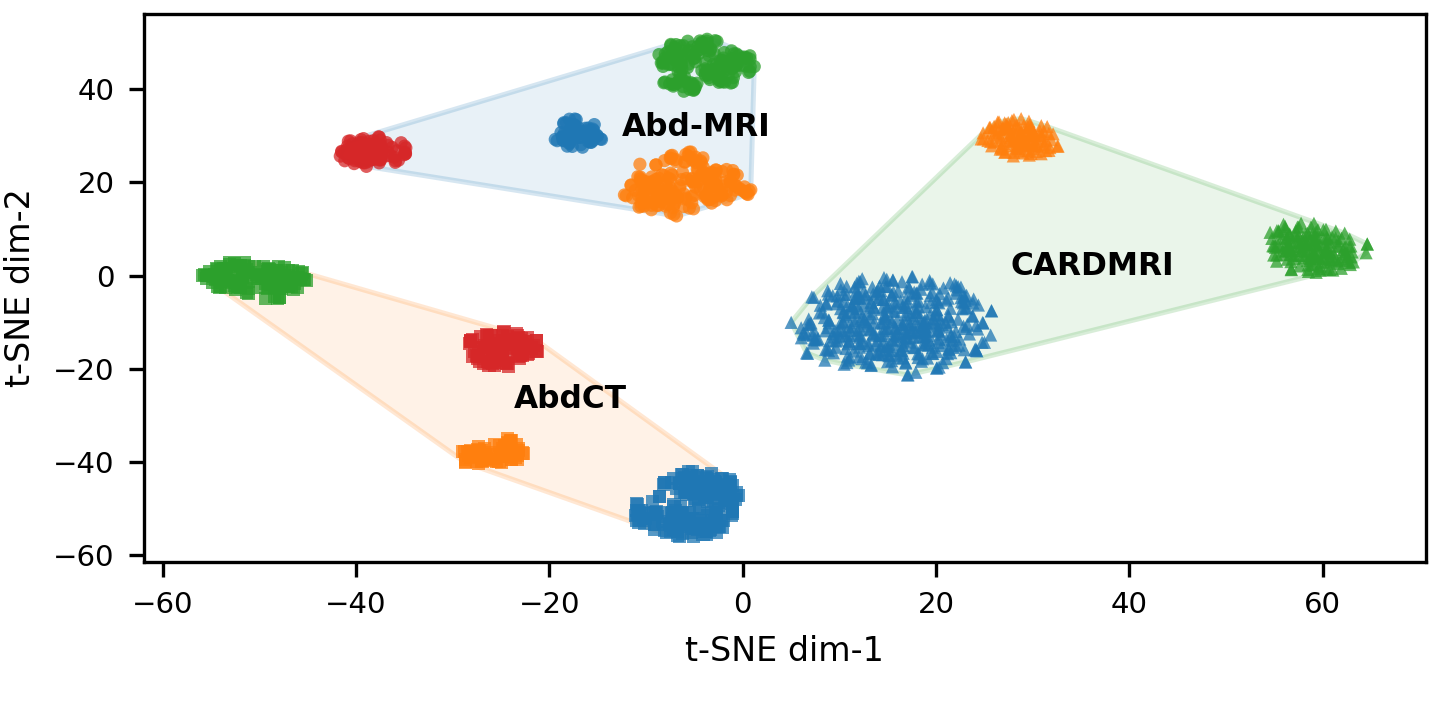
The paper evaluates APEX-SAM on Abd-MRI, Abd-CT, and Card-MRI, covering abdominal organs and cardiac structures with substantial modality and anatomy shifts.

Dataset visualization for Abd-MRI, Abd-CT, and Card-MRI

Figure 2. Dataset visualization and DINO-feature t-SNE for Abd-MRI, Abd-CT, and Card-MRI.

Results

Quantitative Comparison

APEX-SAM achieves consistent gains over training-free and few-shot baselines across abdominal and cardiac segmentation tasks.

Table 1. Dice (%) on Abd-MRI and Abd-CT. Bold indicates the best result and underline indicates the second best result.

MethodRef. Abd-MRI Abd-CT
LiverLKRKSpleenMean LiverLKRKSpleenMean
PANetICCV'1939.2426.4737.3526.7932.4640.2930.6126.6630.2131.94
SSL-ALPTMI'2270.7455.4967.4358.3963.0171.3834.4832.3251.6747.46
RPTMICCAI'2349.2242.4547.1448.8446.9165.8740.0735.9751.2248.28
PATNetECCV'2257.0150.2353.0151.6352.9775.9446.6242.6863.9457.29
IFACVPR'2450.2235.9934.0042.2140.6146.6225.1326.5624.8530.79
FAMNetAAAI'2573.0157.2874.6858.2165.7973.5757.7961.8965.7864.75
MAUPMICCAI'2578.1658.2372.3459.6567.0978.2559.4171.8060.3867.46
APEX-SAM (Ours)MICCAI'2695.1096.8896.0195.2395.8193.4790.2891.8392.0691.91

Table 2. Dice (%) on Card-MRI.

MethodRef.LV-BPLV-MYORVMean
PANetICCV'1951.4225.7525.7536.66
SSL-ALPTMI'2283.4722.7366.2157.47
RPTMICCAI'2360.8442.2857.3053.47
PATNetECCV'2265.3550.6368.3461.44
IFACVPR'2450.4331.3230.7437.50
FAMNetAAAI'2586.6451.8276.2671.58
MAUPMICCAI'2588.3652.7478.2973.13
APEX-SAM (Ours)MICCAI'2692.7568.4188.2383.13

Qualitative

Visual Results and Failure Analysis

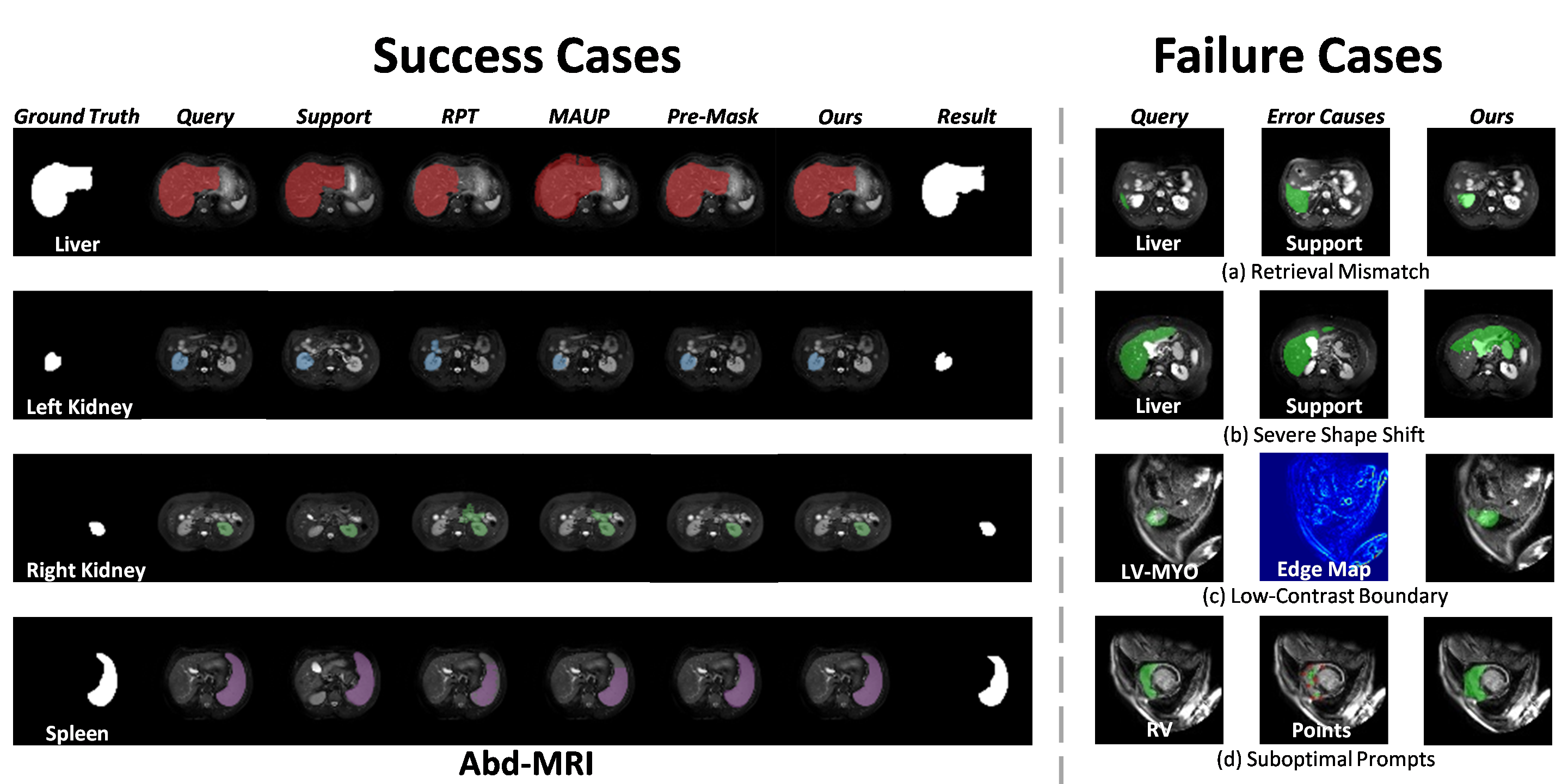
APEX-SAM produces stable cross-domain masks while remaining transparent about remaining challenges such as low-contrast boundaries, severe shape shifts, retrieval mismatch, and suboptimal prompts.

Qualitative results and failure cases

Figure 3. Successful cross-domain masks and representative failure modes.

Ablation

Component Analysis

Each component contributes a measurable improvement, and the thresholded memory update further strengthens the full pipeline.

Table 3. Ablation on core designs (Dice %).

ConfigurationQARAPMHMFMemoryMean Dice
Prompt-only baselineNoNoNo-72.4
+ QARYesNoNoFixed80.2
+ QAR + APMYesYesNoFixed86.3
+ QAR + APM + HMFYesYesYesFixed91.8
Full (Ours)YesYesYesThresholded95.81

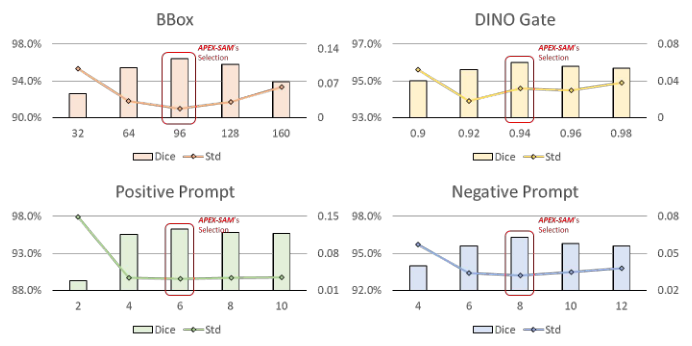
Figure 4. Hyperparameter sensitivity on Abd-MRI.

Hyperparameter sensitivity chart

Mean Dice and standard deviation, with selected values highlighted.

Citation

Citation

Proceedings metadata such as LNCS volume, page range, DOI, and final paper URL will be added after publication.

Mao, Z., Chen, B., Lei, Q., Tan, J., Sun, K.: APEX-SAM: Anatomy-Aware Prompting with Expert Retrieval for Training-Free Medical Image Segmentation. In: Medical Image Computing and Computer Assisted Intervention - MICCAI 2026. Lecture Notes in Computer Science. Springer, Cham (2026).

@inproceedings{mao2026apexsam,
  title     = {APEX-SAM: Anatomy-Aware Prompting with Expert Retrieval for Training-Free Medical Image Segmentation},
  author    = {Mao, Zhihao and Chen, Bangpu and Lei, Qi and Tan, Jiaqi and Sun, Kun},
  booktitle = {Medical Image Computing and Computer Assisted Intervention -- MICCAI 2026},
  series    = {Lecture Notes in Computer Science},
  publisher = {Springer},
  address   = {Cham},
  year      = {2026}
}